by webmaster FAB | Nov 3, 2014 | Featured Slider, News
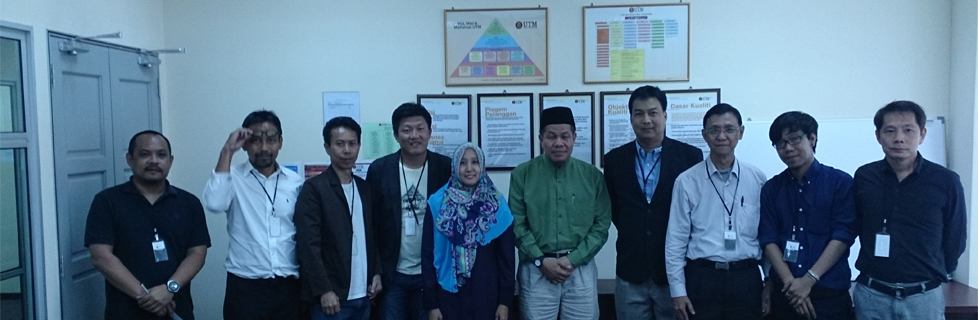
Dr Alice Sabrina (fifth from left) and Assoc. Prof. Dr. Mahmud Mohd Jusan (green shirt) and lecturers from RUTT (left) and Rangsit University (right) after the opening ceremony of the one day workshop at the Faculty of Built Environment, UTM Johor Bahru campus.
JOHOR BAHRU, 27 October 2014 – The International Architecture Collaboration Workshop 2014 was organized through the collaboration between the Faculty of Built Environment of Universiti Teknologi Malaysia (UTM), Faculty of Architecture Rangsit University and Rajamangala University of Technology Thayaburi (RUTT), Thailand.
The workshop was held at the Seminar Room, Centre for the Study of Built Environment in the Malay World (KALAM), Faculty of Built Environment, Johor Bahru campus.
Programme Coordinator, Dr. Alice Sabrina Ismail said that the aim of this workshop was to enhance Malaysia and Thailand relations, through architecture and culture under the theme “Water senses – finding Iconic Architecture”.
“The objectives of this workshop were to establish networking and build mutual relationship with academicians and students, in addition to promoting academicians and students mobility with prominent institutions in the South East Asia Region.”
“Through this programme, research activities and academic collaborations with other renowned South East Asian Universities can also be stimulated,” said Dr. Alice.
Among activities conducted in this one day workshop were Public Lecture sessions where UTM architecture students presented the Malaysian master plan concept and Islamic style architecture, besides sharing the way of local architecture (VERNADOC).
“Participating students from both countries also discussed ‘the inspiration for Architecture’ and shared their views on Iconic Architecture from their own country in a Design Workshop.”
“Architectural work of Thai students themed ‘the future of Thai architecture’ from both RUTT and Rangsit University were also featured in a Design Exhibition held next to the Seminar Room,” said Dr. Alice.
36 architectural students and lecturers from RUTT and Rangsit University participated in this one day programme.
The workshop was officiated by Head of the Architectural Department, Assoc. Prof. Dr. Mahmud Mohd Jusan.
by webmaster FAB | Nov 2, 2014 | Featured Slider, News

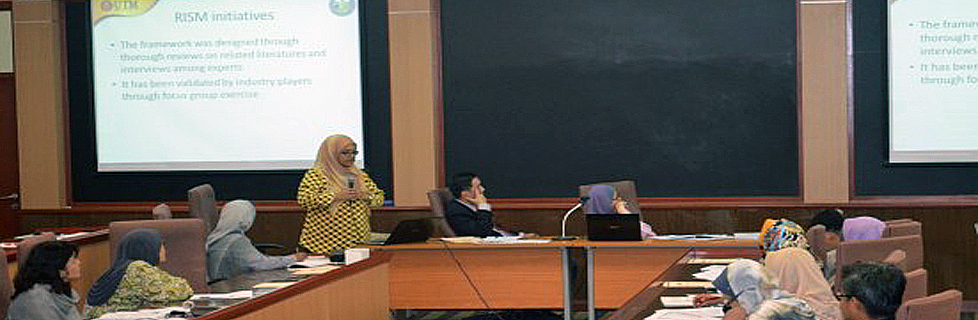
Dr.Kherun Nita Ali, Head of Department of Quantity Surveying, presented Building Information Modelling (BIM) Educational Framework at a Dialogue Session between Quantity Surveying Accreditation Council (QSAC) and Public and Private Institutions of Higher Learning (IHL) at Universiti Teknologi Malaysia, Jalan Semarak, recently.
The framework aims to equip QS graduates with the necessary knowledge and skill in project delivery through the use of BIM. It describes an educational framework for the QS program at the Diploma and Degree level, in the context of BIM implementation that charter the route on how the knowledge on BIM principles and its applications can be imparted to the whole-life inter-disciplinary design and construction with the prime focus is on the QS scope of work.
Dr Kherun Nita, who is also a member of BIM Technical Committee of Royal Institution of Surveyors Malaysia, and Assoc. Prof. Dr Nur Emma Mustaffa derived the framework based on collation of data from a series of interviews with the industry players and extensive reviews on literatures.
The framework was validated by the industry at a focus group session at the International Workshop on BIM Education and Training Content Development on the 20th February 2014 held at Nippon Paint Exhibition Center which was organized by Royal Institution of Surveyors Malaysia (RISM). It was then presented to and accepted by the QSAC and become part of the criteria in accrediting IHL’s QS programs.
The QS profession is taking this new technology as a challenge to be adapted and way forward. BIM offers the capability to generate quantity, counts and measurements directly from a model. From the academic point of view, it requires an enhancement to the existing set of skills and knowledge which the higher institutions’ graduates have to be instilled with.
by webmaster FAB | Oct 29, 2014 | Featured Slider, News
Photo Credit: http://www.amerabra.org/
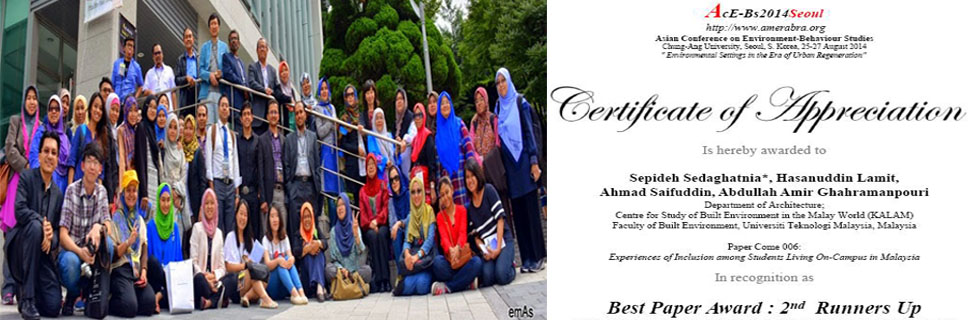
The Universiti Teknologi Malaysia (UTM) Doctor of Philosophy (PhD) candidate student, Sepideh Sedaghat Nia – from Faculty of Built Environment, was selected as a Runner Up Winner at Asian Conference on Environment-Behaviour Studies– “Environmental Settings in the Era of Urban Regeneration”.
AcE-Bs2014Seoul, 2nd Runners Up Winner
Title: Experiences of Inclusion among Students Living On-Campus in Malaysia
Authors: Sepideh Sedaghatnia, Hasanuddin Lamit, Ahmad Saifuddin Abdullah, Amir Ghahramanpouri
Held at Chung-Ang University, Seoul, Korea, this three days conference began on 25 August 2014 and total 77 full papers from Brazil, Egypt, Indonesia, Iran, Japan, Korea, Malaysia, New Zealand, Taiwan, and Thailand participated in the conference.
http://www.amerabra.org/
Cert-Best-Paper-Award-2nd-Runners-Up
by webmaster FAB | Oct 28, 2014 | event, Featured Slider, News
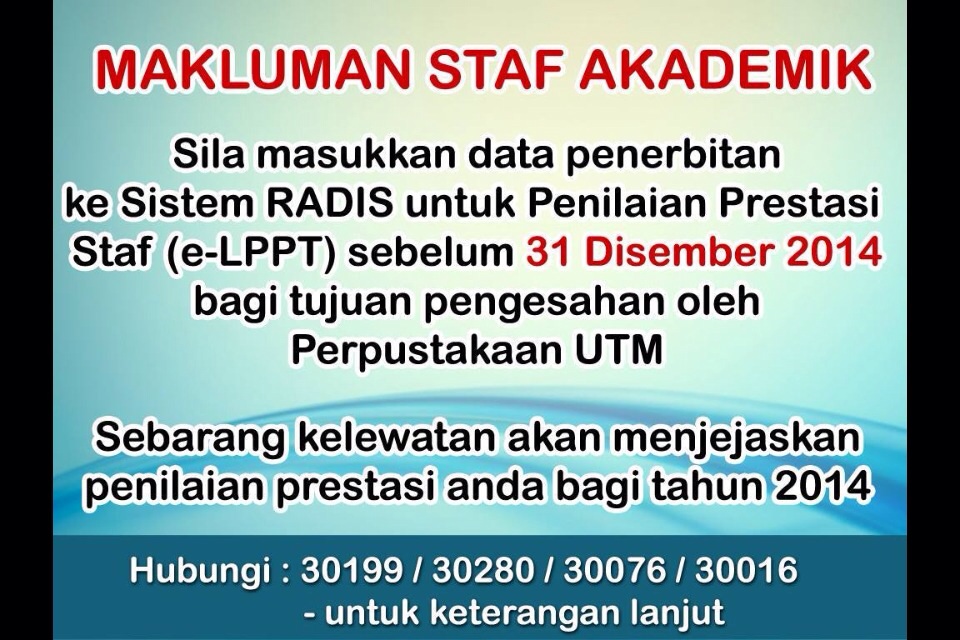
TAHNIAH! kerana saudara telah terpilih untuk menerima Anugerah Medal Fakulti Sempena Konvokesyen Ke-53 UTM.
2. Sukacita dimaklumkan bahawa pemilihan penganugerahan ini adalah berdasarkan pencapaian cemerlang saudara dalam bidang akademik sepanjang pengajian saudara di Fakulti Alam Bina. Oleh yang demikian saudara adalah dijemput bersama ibubapa untuk hadir ke sesi Majlis Penyampaian Anugerah Medal Sempena Konvokesyen Ke-53 UTM seperti berikut:
Tarikh : 1 November 2014 (Sabtu)
Tempat : B12, Dewan Konvensyen, Fakulti Alam Bina
Masa : 2.30 petang
Penyampaian penganugerahan dan pemakaian medal akan disampaikan oleh Dekan Fakulti pada hari tersebut.
Ahmad Nafis Bin Nasurudin
Ahmad Nasaie Bin Md Nor
Chiong Hoe Sieng
Chow Pui Teng
Farkhan Bin Hasan
Geraldine Teoh Pei Lynn
Hidayah Binti A. Rahim
Ibrahim Bin Ismail
Kim Zhao Wei
Lai Chuen Ket
Lee Sai Fong
Mariana Binti Mohamad
Melissa Teh Wyshan
Muhammad Azuan Bin Syahrol
Muhammad Harith Bin Halidan
Ooi Shu Shen
Quek Sze Wei
Tan Ke Wei
Teh Boon Siang
Toorabally Muhammad Faiz
Noor Zulika Binti Din Yati
Abdullah Sufi Bin Ali
Mohammad Asyraf Bin Abd Karim
Mohd Zaki Bin Bahrudin
Muhammad Ainall Syafiq Bin Ahmad
Noratiqah Binti Zasali
Nur Hanisah Binti Zainal Abidin
Ahmad Syahmi Bin Ismail
Murugadass A/L Ganathipan
Siti Hajar Binti Mohd Shahrain
Ang Jia Wen
Foo Hock Siong
Jennifer Lim
Lee Sze Hui
Nur Fatini Binti Abdillah
Ria Delfia Binti Warnis
Tan Sao Yun
Teh Xin Eu
Amy Lau Yin Ying
Jeremy Lau Yee Yin
Kee Jie Sheng
Kong Yean Wei
Lim Jing Qian
Lim Wei Yang
Mohd Khalil Bin Muhamad
Muhamad Solahuddin Bin A. Rani
Muhammad Haiqal Bin Rosli
Nur Dalila Farhanah Binti Zulkifli
Nuraishah Binti Mohamed Noor
Siah Mei Fen
Tan Kae Yunn
Tan Yee Ling
Tan Yi Jing
Teh Chee Jye
Tengku Amirul Asyraf Bin Tengku Ruslan
Wong Chia May
Adilah Binti Jamaludin
Lim Zhi Min
Mlysha Nurshyla Binti Abdul Rahim
Mohamad Safuan Bin Mohamad Kamil
Mohd Fadzil Bin Abdullah
Mohd Khairuddin Bin Perak
Nadhirah Binti Nordin
Najeehah Binti Roslan
Norfazdlina Binti Mohd Khalil
Nurul Farahen Binti Ibrahim
Priscilla Yong Chang Hua
Rohayu Binti Abdullah
Shahrul Nizam Bin Ahmad
by webmaster FAB | Oct 27, 2014 | News
by webmaster FAB | Oct 20, 2014 | Featured Slider, News
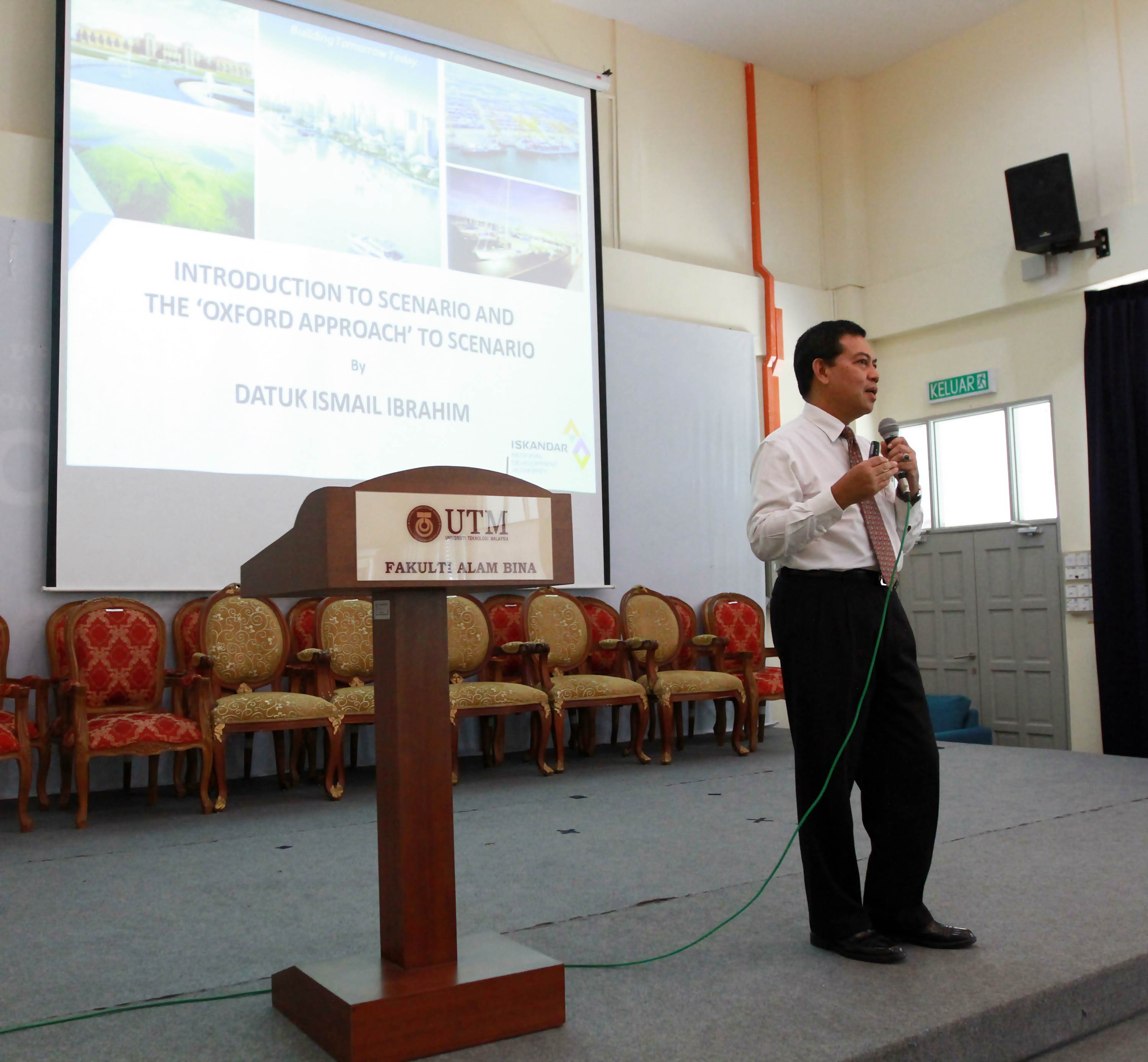
The Department of Urban and Regional Planning, Faculty of Built Environment had its first public lecture entitled “Scenario Planning for Iskandar Malaysia” by Ajunct Prof., Y.Bhg. Datuk Prof. Ismail bin Ibrahim, Chief Executive, Iskandar Regional Development Authority (IRDA) on 9 October 2014. The lecture was held at Convention Hall, B12, Faculty of Built Environment and was attended by students and academic staff of the Department of Urban and Regional Planning and other faculties in the University. The lecture was essentially an introduction to Scenario Planning and specifically, the “Oxford Approach” to Scenario Planning. During the lecture it was emphasized that scenario planning sets out what may or could happen in the future based on today’s observation. It is an alternative “future context” based on current realities and that scenarios are used for intervention. It was further emphasized that understanding the client and client’s needs are crucial for a purposeful intervention – “best fit to the client’s need”. This was Datuk Prof. Ismail’s first lecture for academic session 2014/2015 and his third for 2014.