by webmaster FAB | Apr 8, 2015 | Featured Slider, News
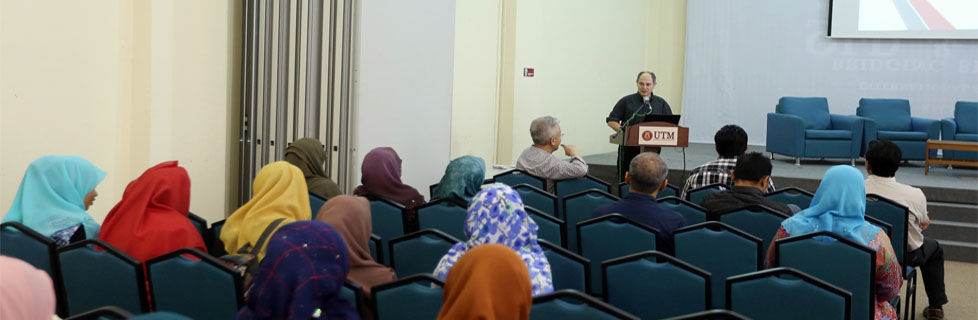
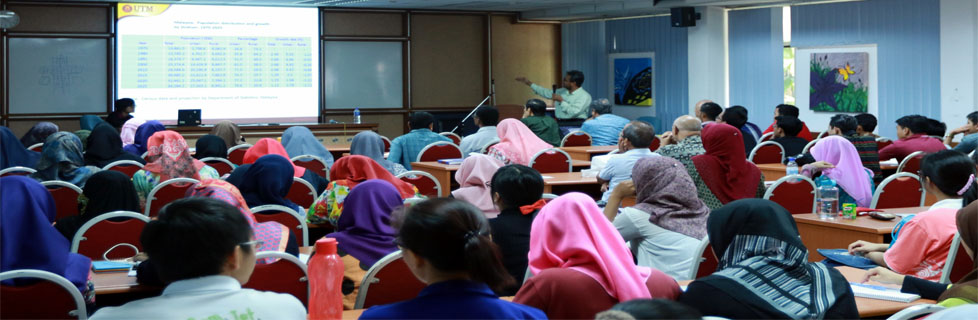
On 25th March 2015, Centre for Innovative Planning and Development (CiPD), UTM organised their first Seminar in 2015. The Talk was delivered by Prof. Dr. Alan A. Lew from Department of Geography, Planning and Recreation, Northern Arizona University, USA. The 2 hours public lecture titled ‘The Four Faces of Community Sustainability and Resilience’ was based on four essential areas of concern namely Management Resilience, Sustainability Resilience, Planning Resilience, and Governance Resilience. Each of these areas has distinct implication for sustainable development and resilience planning in the research and applied methodologies.
Prof. Alan A.Lew, who was graduated his PhD in Geography from University of Oregon, Eugene in 1986, and also a member of American Institute of Certified Planners, has a lot of experience in tourism geography and global issues in tourism places. As the Editor-in-Chief, Tourism Geographies, an International Journal of Tourism Space, Place and Environment since 1999, he also stressed that the issues of sustainable tourism and resilience become among the current issues in tourism geography.
The seminar was attended by about 100 lecturers, postgraduates and undergraduates students from Department of Urban and Regional Planning and Department of Landscape Architecture, Faculty of Built Environment. The seminar ended at 12.30pm with Q and A sessions by the students and lecturers.
Image Gallery
by webmaster FAB | Apr 8, 2015 | News
Dear UG and PG Students,
In my webpage https://builtsurvey.utm.my/fabu2024/ismail/, I have compiled a total of 56 notes of my lectures and talks on research findings and postgraduate studies at https://builtsurvey.utm.my/fabu2024/ismail/lectures-and-public-talks/. Some of the new topics include Writing a PhD Thesis, Tips on Attending a Viva-voce, Journey to Graduation, and Constructing Research Conceptualization. Within these notes, you can find notes on my past research which include Place Attachment of Residents to Green Infrastructure Network in Small Town, People and Place Bonding in Urban Environment, Carving Motifs in Timber Houses of Kelantan and Terengganu, and Place for Children and Children Place. In addition, you can access PhD topics, abstracts, viva slides, research reports and research proposals of my past students at https://builtsurvey.utm.my/fabu2024/ismail/phd-students/. Likewise, you can view the documents of my master graduates at https://builtsurvey.utm.my/fabu2024/ismail/master-students/. Happy reviewing!
by webmaster FAB | Apr 8, 2015 | News
New research topics of Assoc. Prof. Dr. Ismail Said’s PhD students:
1. Ecosystem resilience in fragmented urban green spaces in small towns in Malaysia (Noraini Bahari)
2. Ecosystem services assessment and modeling for trade-off melioration in urban-rural gradient (Yeo Lee Bak)
by webmaster FAB | Mar 25, 2015 | Featured Slider, News

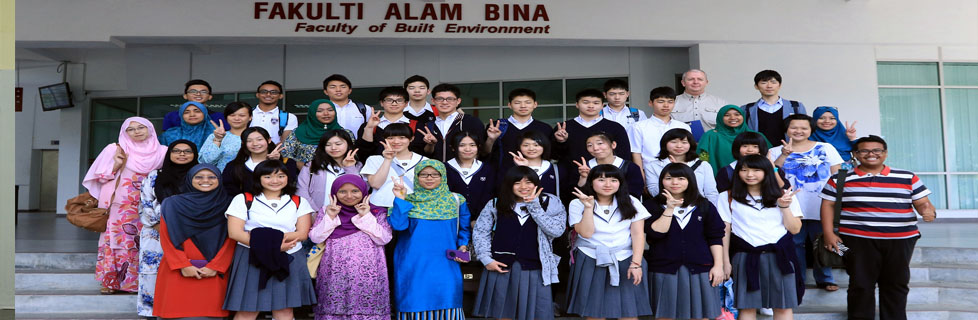
The Faculty of Built Environment (FAB), UTM was host to a group of 21 students and 2 teachers from Seifu Nankai High School, Osaka, Japan on March 18th 2015. The group was led by Mr.Toshiyuki Iwawaki and Mr. David Eckford, teachers from Comprehensive and International Department, Seifu Nankai High School. The main purpose of the academic visit was to establish relations with UTM under the ‘Global Young Leaders Programme’. The programme provides a platform for young leaders of the future to play an active role in the betterment of society and attain a wide range of knowledge on economic, societal, technological and political issues through seminars.
During the visit, students were given two (2) lectures entitled Iskandar Malaysia Development and Tourism and Malaysian Socio-Economic Culture by Dr. Norhazliza Abd Halim and Dr. Nafisa Hosni respectively. It is then followed by a group discussion amongst students from the Department of Urban and Regional Planning, FAB and Seifu Nankai High School.
Mr. David Eckford, an Australian citizen teaching English at the school said that the programme is an initiative of the Japanese Government’s Super Global High School Program as part of an Overseas Study Program. The visit is envisaged to provide an avenue for student activities such as student seminars, discussions, student exchange and academic tour.
The half-day academic visit ended with a campus tour led by Dr. Norhazliza Abd Halim.
Image Gallery
by webmaster FAB | Mar 25, 2015 | Featured Slider, News
In essence, rural development is a process and is very much outcome based. It is a process of deliberate induced change led by the state and is multidisciplinary and the outcome is for the betterment of the rural population, for example, improved quality of life, increased income and productivity, reduced poverty, better infrastructure, health, education etc. In 1970 the rural population accounts for about 73 % of total population and steadily declined to 38% in 2000, 25.7 % in 2015 and is anticipated to decline further to 22.8 % in 2020 and 20.4 % 9n 2025. Average gross monthly household income of the rural population is less than half of the urban population. The continued decline of the rural population has given rise to issues of out-migration, aging, shortage of labour, social problems especially drug abuse, land fragmentation, lack of employment amongst youth, dependency on government etc. For example, out-migration among the youth especially between the ages of 20-29, in the rural areas is high, about 36.6%. Although poverty has declined significantly since 1970, however, the incidence of poverty is still common in the rural areas and is expected to continue. He also cited the various rural development strategies and programmes introduced in Malaysia since the 1960s. Prof. Dr. Ibrahim concluded his presentation by disclosing some of the challenges that will confront the rural areas and society. The Department was also privileged to have Mr. Tang Liang Hong, a retired lawyer and a “senior” postgraduate student of the Faculty, speak and reflect upon the global challenges that Malaysia will indisputably have to face. He made reference to the “new opportunities and new future” that is likely to be brought about by “the new silk road” specifically and to call to mind if Malaysia and the rural communities are ready to exploit the new opportunities and future for the betterment of the rural areas and the country.
The seminar was held on 12th March 2015 (Thursday) at Seminar Room, Level 3 B03, Faculty of Built Environment and was attended by students and faculty.
Image Gallery